Or to retain the status quo where the decisions that affect the people of Cornwall are made from a centralised government that’s currently proposing Cornwall be governed by an administrative body in Devon?
‘The decision to recognise the unique identity of the Cornish, now affords them the same status under the European Framework Convention for the Protection of National Minorities as the UK’s other Celtic people, the Scots, the Welsh and the Irish. For the first time the government has recognised the distinctive culture and history of the Cornish’.
The nation of Cornwall has not been afforded similar status to that of the other Celtic nations. Scots and Welsh describe their road towards independence as ‘a journey, not a destination’. Cornwall too is on a similar journey in its quest for recognition and similar autonomy through a Cornish Parliament, or to be more accurate, ‘the return’ of Cornwall’s identity and autonomy through a devolved Cornish parliament.
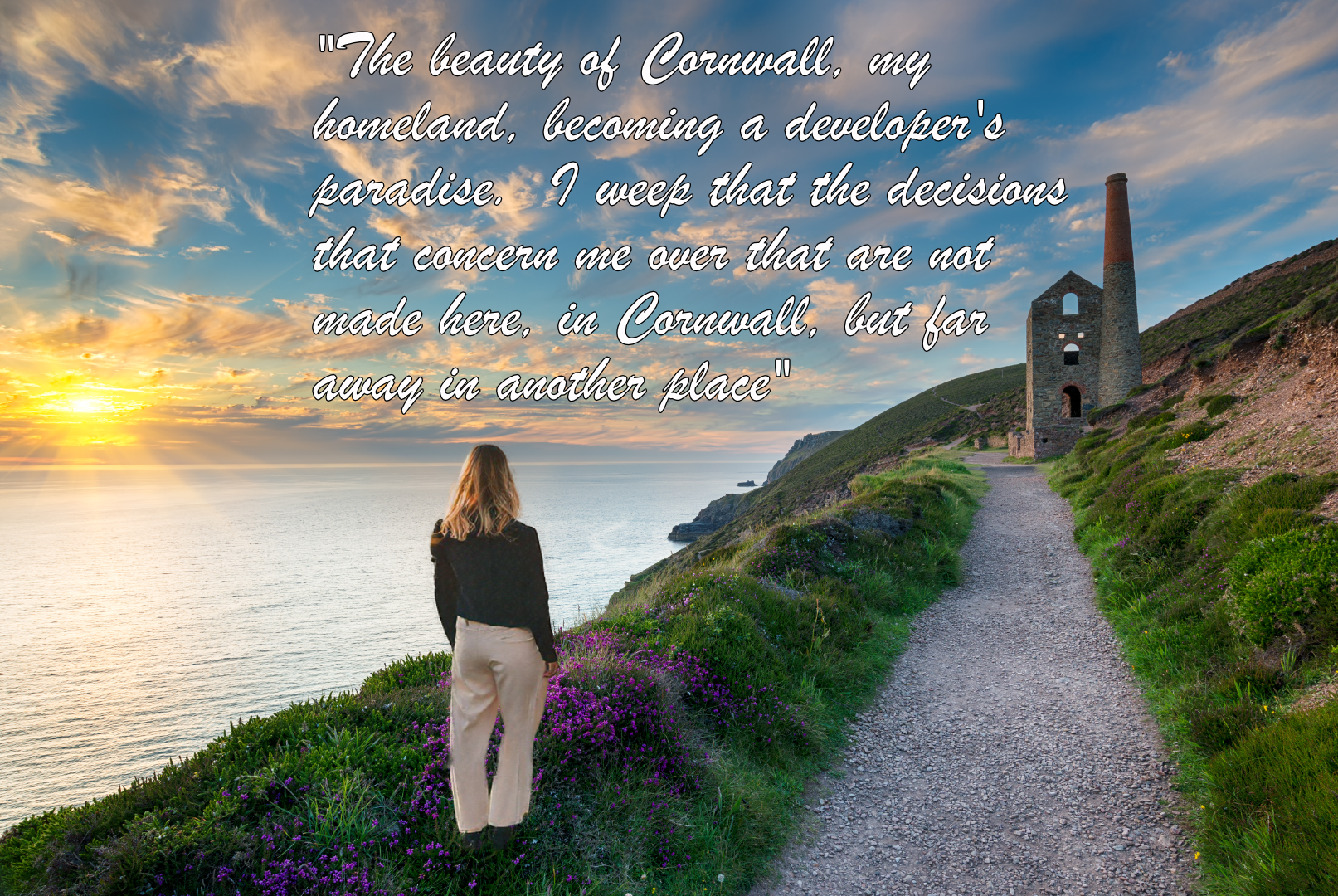
The emergence of a newly created English state and the invention of its ‘British Project’ which Professor Philip Payton ‘Cornwall – A History’ explains ‘was the strategy by which the English state sought to ‘legitimise’ its military expansion into Celtic Britain’ served to marginalise Cornish history either by ignoring it, or by appropriation as a subsidiary of a central English theme.
This continues today throughout schools in Cornwall, England’s school curriculum excludes Cornish history and language. Although the Cornish high-pressure steam inventor Richard Trevithick, or the Cornish chemist and inventor Humphrey Davy might get a mention, it remains out of context, as it fails to include Cornwall’s Celtic past from which Cornish identity, language and culture emerged.
The current curriculum effectively leaves Cornish children having little knowledge of their Cornish past that includes centuries of upheaval and struggle to retain its autonomy; including the Cornish risings in 1459 against England’s extortionate taxes imposed upon Cornish minerals, already highly taxed, to fund its military battles against Scotland, and the rising in 1549 against an imposed English language prayer book, leaves Cornish children little option but to assume English identity. Some conclude that the curriculum is ‘assimilation by the state’ and in contravention of the Framework Convention for the Protection of National Minorities, that states in Article 5:
- The Parties undertake to promote the conditions necessary for persons belonging to national minorities to maintain and develop their culture, and to preserve the essential elements of their identity, namely their religion, language, traditions and cultural heritage.
- Without prejudice to measures taken in pursuance of their general integration policy, the Parties shall refrain from policies or practices aimed at assimilation of persons belonging to national minorities against their will and shall protect these persons from any action aimed at such assimilation.
That might explain why some born and raised in Cornwall, resolutely resist identifying as Cornish. The extent to which the ongoing political campaigns for the return of Cornish self-governance are firmly cast aside, dismissed using arguments evident of an ignorance, lack of understanding, and perhaps suggesting a willing acceptance of England’s assimilation? Could this be the reason why support for a Cornish Assembly/Parliament, doesn’t get the support it would otherwise receive? Therefore making the journey towards Cornwall having effective self-government that much longer to achieve.
Also, there are others that do identify as Cornish, but (either through a lack of self-confidence or fear of hostile argument) are reluctant to stand up for their Cornish identity publicly. Choosing instead to assimilate as the path of least resistance and possible confrontation from their detractors.
There are those that have moved to Cornwall, discover a love, an empathy and feel a sense of belonging, and embrace Cornish identity. To then go further, learning the Cornish language, promoting Cornwall’s identity, and more likely to support an Assembly/Parliament.
Cornwall’s local election
Last year at a full Cornwall Council meeting, a motion was presented in support of a Cornish Assembly/Parliament. The motion failed. While disappointing, the motion was lost by only two votes, one from Council leader, Linda Taylor.
The forthcoming election on May 1st could see those that failed to support Cornwall being recognised with similar status as Wales and Scotland being removed and replaced by councillors that do give their support.
Professor Charles Thomas warned earlier that “Cornwall is approaching some sort of internal social crisis. It is increasingly difficult to be Cornish. It is correspondingly important for those who are Cornish, and presumably value their identity, to stand up and be counted . . . If we do not succeed, this little land of ours will end up scarcely distinguishable from the Greater London Area, with undertones reminiscent of Blackpool or Skegness”.
Furthermore, if Cornwall fails to support a Cornish Assembly/Parliament, with no primary devolved legislation, the people of Cornwall won’t benefit from the changes they demand from Cornwall Council that serves the polices handed down from Westminster, not Cornwall’s electorate.
Cornwall, as the media on the other side of the Tamar would have it, will remain in a ‘Devon and Cornwall’ ‘South West’ ‘Our region’ or ‘county’ construct.
Cornwall, the decision is yours.
 CORNOVIA